- PhD project on oscillatory diagnostics of Parkinson’sWe are looking for an eager and enthusiastic PhD student to join our team at the University of Dundee and conduct ground-breaking research into diagnostic brain signatures of Parkinson’s disease (PD). The project will provide ample opportunities to work both in cognitive neuroscience and clinical environments and aims to develop a diverse skill set, including – but not limited to – neuroimaging brainwaves using EEG, … Continue reading “PhD project on oscillatory diagnostics of Parkinson’s”
- Join our ESCoP 2023 symposiaAnne and I both co-chair Symposia at ESCoP 2023 in Porto. Join us or get in touch for a chat. Abstracts below. (Scroll down to see TABlab posters.) PREFERRED RHYTHMS IN AUDITORY COGNITION Thu 16:40-18:20 Organisers: Anne Keitel (1), Anne Kösem (2) 1-University of Dundee, 2-Lyon Neuroscience Research Center (CRNL) Talks by: Christina Lubinus, Ayelet Landau, Benedikt Zoefel, Anne Kösem, Anne Keitel The last two … Continue reading “Join our ESCoP 2023 symposia”
- New preprint: The visual cortex extracts spectral fine details from silent speechA guest blog post by Nina Suess In our new preprint, we tried to find out what speech-related information can be extracted from silent lip movements by the human brain and how this information is differentially processed in healthy ageing. It has already been shown that the visual cortex is able to track the unheard speech envelope that is accompanying the lip movements. But the … Continue reading “New preprint: The visual cortex extracts spectral fine details from silent speech”
- Out now: Commentary on infant entrainment study
 Our* commentary on Köster et al. (2019) Psych Sci is now available here. Find a TL;DR below. Entraining rhythms of the brain to study the neurodevelopment of perception and cognition is a fascinating idea. In principle, entrainment endows the experimenter with increased control over the timing of fundamental neural processes. Yet, its appeal has also created a flurry of neuroscientific research that may apply this … Continue reading “Out now: Commentary on infant entrainment study”
 - Out now: The brain separates auditory and visual “meanings” of words
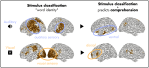 In our new article, we tried to find new answers to an old question: Are word meanings “the same” in the brain, whether we hear a spoken word or lip-read the same word by watching a speaker’s face? After more than 4 years of work (I tested the first participant in August 2016), this study now found a great home in the journal eLife. We … Continue reading “Out now: The brain separates auditory and visual “meanings” of words”
 - Call for Papers – Rhythms in cognition: re-visiting the evidenceSpecial issue at the European Journal of Neuroscience now open for submissions. Guest Editors Christian Keitel (University of Stirling, UK), Manuela Ruzzoli (University of Glasgow, UK), Chris Benwell (University of Dundee, UK), Niko Busch (University of Muenster, Germany), and Laura Dugué (Paris Descartes University, France). Call for Papers: November 2019 Extended Submission Deadline: December 21, 2020 Online Publication within One Week of Acceptance Estimated Date … Continue reading “Call for Papers – Rhythms in cognition: re-visiting the evidence”
- New preprint: The brain separates auditory and visual “meanings” of wordsIn our new preprint, we tried to figure out whether word meanings are “the same” in the brain, whether we hear a spoken word or lip read the same word by watching a speaker’s face. To answer this, participants did the same task in two conditions: auditory and visual. In the auditory condition, they heard a speaker say a sentence. In the visual condition, they … Continue reading “New preprint: The brain separates auditory and visual “meanings” of words”
- Flicker-driven brain waves and alpha rhythms – revisited
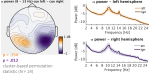 In our recent study we asked how waves that the brain produces by itself – alpha rhythms – relate to waves triggered by viewing a flickering screen. Both can be of similar frequency (~10Hz, or ten cycles per second) and are easily recorded from the scalp with electrodes (EEG). To recap, we did not find much evidence for a strong link between the two types … Continue reading “Flicker-driven brain waves and alpha rhythms – revisited”
 - CNS 2019 – PostersWe will be presenting our works at Poster Session F, Tue (26 Mar), 8-10am, at the 2019 CNS meeting in San Francisco. Go see Anne for Auditory and visual speech perception is predicted by distinct cortical encoding networks [F60]: And stop by at [F130] for Christian’s Spontaneous fluctuations of pupil size and brain rhythms co-vary at rest: … or just click on the posters to … Continue reading “CNS 2019 – Posters”
- Alpha rhythms: Some slow down, some grow stronger
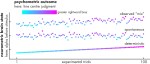 Researchers usually assume alpha brain waves to behave relatively similarly over time. In a new study, led by Chris Benwell and just accepted for publication in NeuroImage, we find that this is not necessarily true for the 1-2 hrs that a typical EEG experiment lasts. In a re-analysis of data from two previous EEG experiments we saw that alpha underlies two major trends – alpha … Continue reading “Alpha rhythms: Some slow down, some grow stronger”
Skip to content

 A/C Keitel