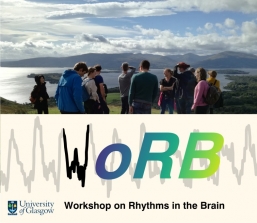
First WoRB – Workshop on Rhythms in the Brain – concluded

Last week the first Workshop on Rhythms in the Brain – WoRB – took place here in Glasgow, at the Institute of Neuroscience & Psychology. The organisers thank our speakers Satu Palva, Ayelet Landau, Hartwig Siebner & Niko Busch for their inspiring talks, great discussions and joining our hike up Conic Hill.

Also thanks to everyone who attended the talks, found the time to meet with our guests and our fantastic Admin team, who made it all happen.


news-photo.jpg

Accepted paper: Spontaneous and deterministic fluctuations of pre-stimulus alpha power govern biases in visual line bisection

Chris Benwell’s most recent study shows that an observer’s brain state, just before seeing a transected line, influences their judgment of its centre. Also, these critical brain states do not seem to fluctuate randomly from instant to instant, but trend systematically over time.

Brain states can be defined by rhythmic activity in characteristic frequency bands. We know that the alpha rhythm (roughly ten cycles per second) plays its role in how we take in the visual world around us. For example, strong alpha can shield us from visual impressions. Weak alpha allows for more sensory intake.

Until recently this role of alpha had mostly been shown for briefly presented light flashes just bright enough to be on the verge of being visible. But Chris’ study suggests that alpha may be a gatekeeper for other aspects of visual processing in the brain, too. Here, observers judged whether a line was transected left or right of its centre. Crucially, alpha power before line presentation influenced this judgment.

Line stimuli – Observers had to judge whether lines were interrupted left or right of their actual centre.

More surprising however was that fluctuations in alpha power didn’t come as spontaneous or random as previously thought. Instead, the time observers spent on the task seemed to play a role – at least to some extent. Alpha simply increased over the course of the experiment. And here’s the novel aspect: This deterministic trend predicted a gradual shift in line centre judgments from trial to trial. On average, observers judged the centre to be more to the right than it actually was.

In brief, Chris’ experiment showed that alpha not only influences whether we see very faint stimuli but also how we make judgments about the centre of a visual object. Also, alpha does not just fluctuate randomly but has a deterministic component: When performing a task for an extended period of time alpha inclines gradually. This leads to a sustained and predictable change in our visual perception.

benwellBlog_eff.jpg

Schematic of spontaneous and deterministic influences of alpha (a neurometric) on reported line center (a psychometric) – the colour gradient towards purple indicates that observers showed an increased rightward bias over time meaning that they increasingly judged the line centre more right than it actually was.

These findings beg an interesting question for future research: Can we find other determinants of alpha (i.e. brain state) fluctuations? Moreover, can all ‘spontaneous’ fluctuations ultimately be described by deterministic processes?

The paper has just been accepted for publication in the European Journal of Neuroscience, and can be found here.

Reference
Benwell CSY, Keitel C, Harvey M, Gross J, Thut G (accepted) Trial-by-trial co-variation of pre-stimulus EEG alpha power and visuospatial bias reflects a mixture of stochastic and deterministic effects. European Journal of Neuroscience

This paper is part of the EJN special issue “Neural Oscillations”.

WoRB – Workshop on Rhythms in the Brain – ready to go

Proudly we announce the first Workshop on Rhythms in the Brain (WoRB) held in Glasgow on Monday, 11 Sep 2017. WoRB sets the stage for four leading experts – Satu Palva, Ayelet Landau, Hartwig Siebner & Niko Busch – show-casing and discussing their state-of-the-art research in this intense half-day programme.

WoRB aims to gather a broad audience interested in the significance of rhythmic brain activity for cognitive function.
Two key aspects will be in the spotlight:
1) What do brain rhythms code for and how do they give rise to the complexity and efficiency in human behaviour?
2) How can we drive brain rhythms and establish their causal role in cognition through brain stimulation?

The WoRB format delivers condensed talks with opportunity to discuss and get together with the speakers during breaks.
It is our hope that WoRB fosters scientific exchange and spawns future perspectives for research into the functional role of intrinsic brain rhythms.

Programme:

  • 09:00 Registration
  • 09:20 Welcome
  • 09:30 Hartwig Siebner:
    Perspectives of state-informed non-invasive transcranial brain stimulation (NTBS): Creating a “state” or targeting a “state” with NTBS?
  • 10:15 Ayelet Landau:
    Attentional Sampling: a human exploration mechanism
  • 11:00 Coffee Break
  • 11:15 Niko Busch:
    Alpha Oscillations, Neuronal Excitability, and Perceptual Decisions
  • 12:00 Satu Palva:
    Entraining and modulating oscillations with TMS
  • 12:45 Lunch
  • 13:30 End of Session

More info here

Organised by Joachim Gross & Gregor Thut Organising Committee Christian Keitel (Chair), Domenica Veniero, Hyojin Park, Roberto Cecere & Christopher Benwell Website Marc Becirspahic WoRB logo courtesy of Christoph Daube Administrative support Lindsay Wilson & Alice Lee

Accepted paper on audio-visual synchrony and spatial attention

In this project, spearheaded by first author Amra Covic, we investigated the interplay of synchronised audio-visual (AV) stimuli and paying attention to their location.

AV stimuli typically have a processing advantage over unisensory stimuli. Current accounts ascribe this advantage to a secondary process, an automatic attraction of attention. We were thus surprised to find that AV and spatial attention influenced stimulus processing independently and additively, instead.

Our study made use of the frequency tagging (FT) approach. FT allowed us to keep track of two simultaneously presented stimuli. Classically stimuli flicker by switching them on and off. Here, we implemented an extra stimulus rhythm by periodically changing the shape of our grating-like stimuli (Gabor patches).

The paper has just been accepted for publication in NeuroImage.
Find the final version here: bioRxiv. ~PDF